How Does Testing Data Lead to the Right Pavement Repair Recommendation?
Services:
Markets:
Contact Us
We are committed to reliable, responsive communication with our clients and potential clients. Our employee-owners are here to help and answer any questions you may have. We look forward to hearing from you.
How Does Testing Data Lead to the Right Pavement Repair Recommendation?
Why testing data matters before selecting a repair approach
Testing answers the first set of questions about a pavement system. What exists below the surface, how it is performing, and where variability occurs. The next step is using that data to determine which repair approach will perform as intended over time.
Without this step, repairs are often based on surface conditions alone, which can overlook underlying issues that affect long-term performance.
How do you build an accurate picture of existing pavement conditions?
We start by combining multiple data sources to understand both surface and subsurface conditions:
- Ground Penetrating Radar (GPR): Provides continuous thickness data across the pavement
- Cores and borings: Confirm layer thickness and evaluate material condition
- Visual assessments: Identify surface distress patterns
When used together, these tools provide a more complete picture than any single method.
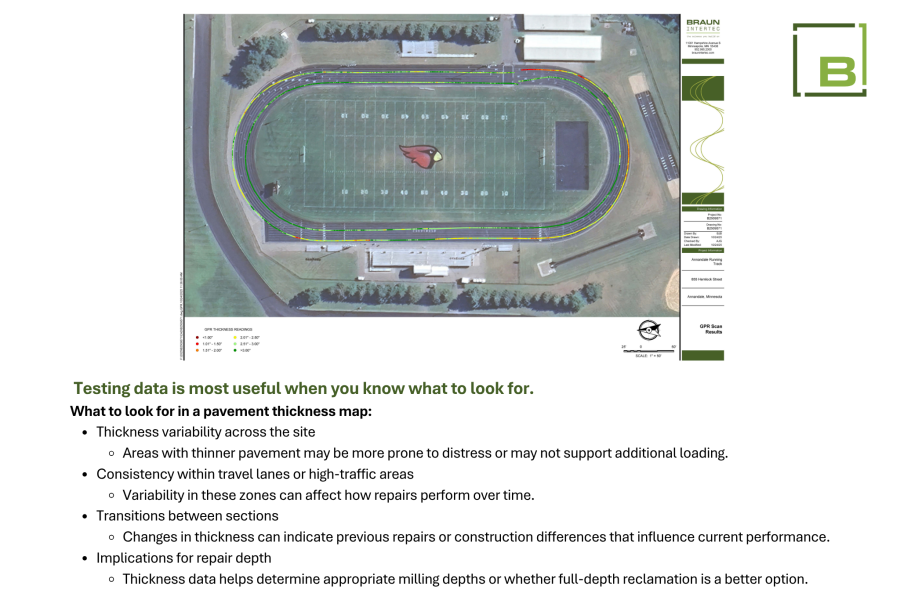
For example, GPR data can be visualized as a heat map to show variations in pavement thickness. This helps identify areas that are thinner or thicker across the site. This provides information that directly influences milling depths or the feasibility of recycling options.
How is structural capacity evaluated?
Understanding pavement thickness is only part of the equation. Structural capacity determines whether the pavement can support current and future loading.
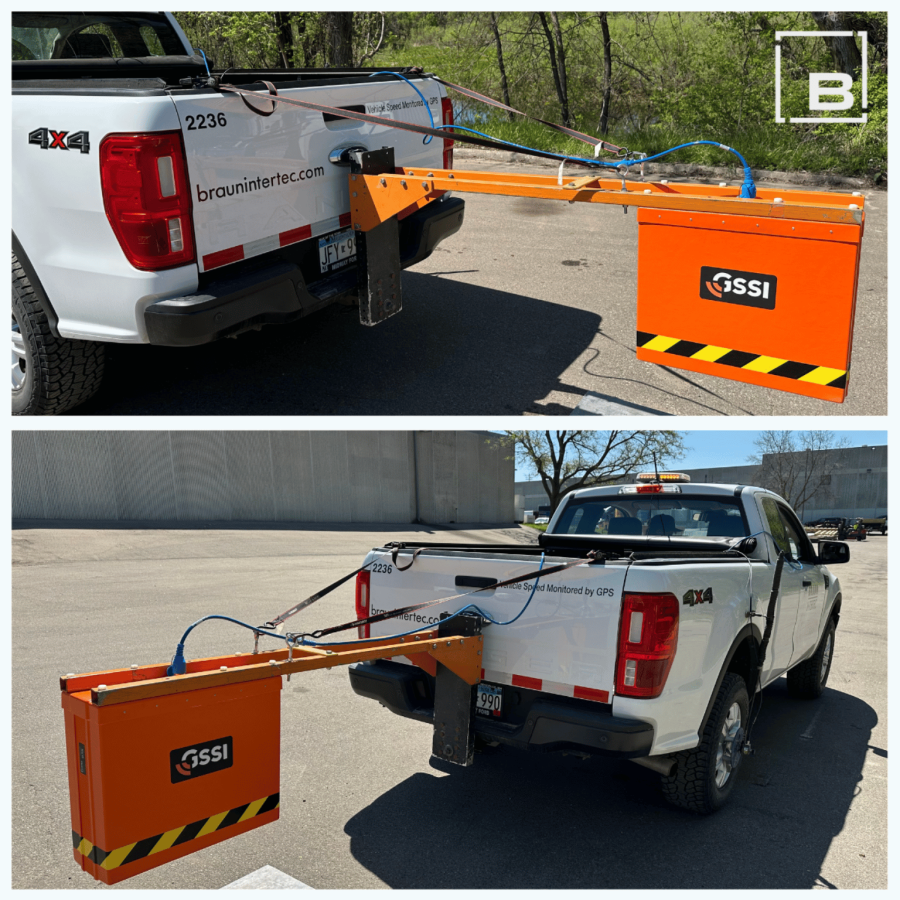
We use Falling Weight Deflectometer (FWD) testing to estimate:
- Pavement response under load
- Subsurface support conditions
- Required overlay thickness where applicable
This step helps quantify what the pavement can carry today and what it needs to perform in the future.
How does testing data guide repair recommendations?
Once existing conditions and structural capacity are defined, we evaluate viable repair approaches. These may include:
- Mill and overlay where the underlying pavement is in acceptable condition
- Reclamation or recycling where deeper issues exist
- Full reconstruction for severely distressed sections
Testing data helps eliminate options that may appear viable on the surface but are unlikely to perform.
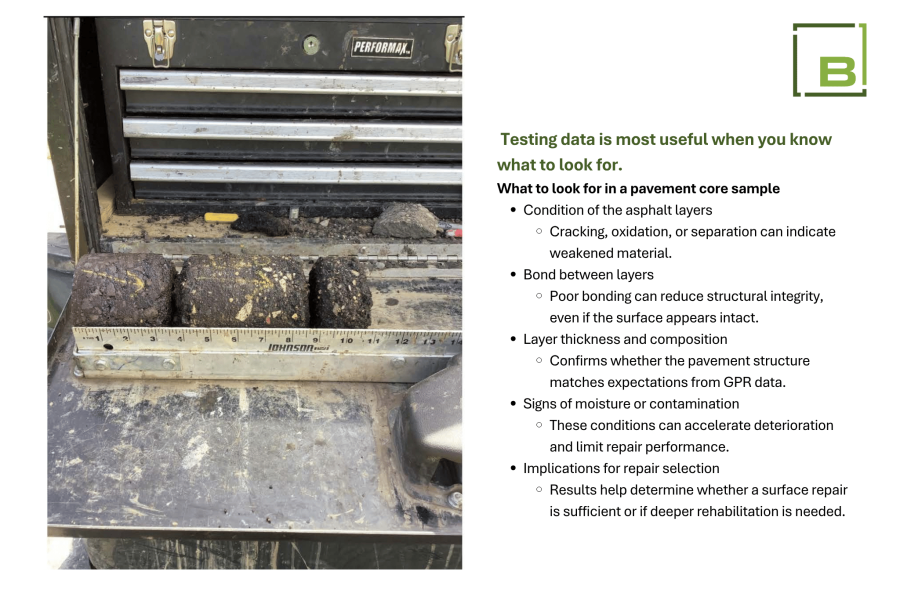
For example, core samples may show that the underlying bituminous material is not in sound condition. In these cases, a shallow mill-and-overlay may not address the root issue, while recycling or reclamation can create a more stable structure and extend service life.
https://www.braunintertec.com/contactHow do project constraints influence the final recommendation?
The right repair approach must also align with project constraints, including:
- Budget limitations
- Construction schedule
- Traffic impacts
- Long-term performance goals
We use testing data to evaluate tradeoffs between these constraints so clients can make informed decisions.
What does the final deliverable include?
A final pavement evaluation typically includes:
- Testing summaries and data visuals
- Pavement thickness mapping (e.g., GPR heat maps)
- Core photos and logs
- Structural analysis results
- Repair recommendations aligned to site conditions
These deliverables are designed to clearly communicate both findings and rationale.
Getting to the right repair, in the right location, at the right time
Testing data allows us to move beyond assumptions and target repairs where they are needed most. This helps reduce the risk of premature failures and supports better long-term pavement performance.
If you’re evaluating pavement repairs, we can help you understand the underlying conditions and identify repair options aligned with your project goals. Let’s start with a conversation about your site. Contact Us
Services:
Markets:
Contact Us
We are committed to reliable, responsive communication with our clients and potential clients. Our employee-owners are here to help and answer any questions you may have. We look forward to hearing from you.