Inside the Lab: CIR and SFDR Mix Design
Services:
Markets:
Contact Us
We are committed to reliable, responsive communication with our clients and potential clients. Our employee-owners are here to help and answer any questions you may have. We look forward to hearing from you.
Inside the Lab: CIR and SFDR Mix Design
What Happens After Pavement Coring, GPR and FWD Testing
Asphalt pavement recycling can be a smart rehabilitation strategy, but it is not one size fits all. The performance you get depends on what is already in the roadway, what the field testing tells us about structure and variability, and how the recycled material is designed. That is why the lab mix design matters! It helps us optimize performance while keeping the stabilizer content cost effective and aligned with design requirements.
This is the third post in our pavement evaluation series. In earlier steps, pavement coring, Ground Penetrating Radar (GPR) and Falling Weight Deflectometer (FWD) testing help define existing conditions and structural response. The next step is turning those inputs into a stabilization recommendation you can trust.
Why Mix Design Matters for Recycling
When a roadway is a candidate for Cold In Place Recycling (CIR) or Stabilized Full Depth Reclamation (SFDR), the design goal is simple: identify the best stabilizing agent and stabilizer percentage that meets performance requirements at the lowest practical cost. The lab process gives us a controlled way to evaluate the recycled material, compare stabilizer contents, and reduce uncertainty before construction begins.
For owners and agencies, that translates into better decision support:
- More confidence in the recommended approach
- Better alignment between design intent and field performance
- Less risk of surprises during construction
- Better long-term pavement performance and value from the rehabilitation budget
Inputs: What We Learn from the Field
Before the lab work starts, we rely on field information to shape the design approach.
GPR identifies pavement layer thicknesses and variability in those layers. Cores confirm pavement layer thicknesses and help us understand material condition. FWD testing helps us evaluate pavement response and structural needs. Together, these data points inform the recommended design framework we take into the lab.
What the Lab Does
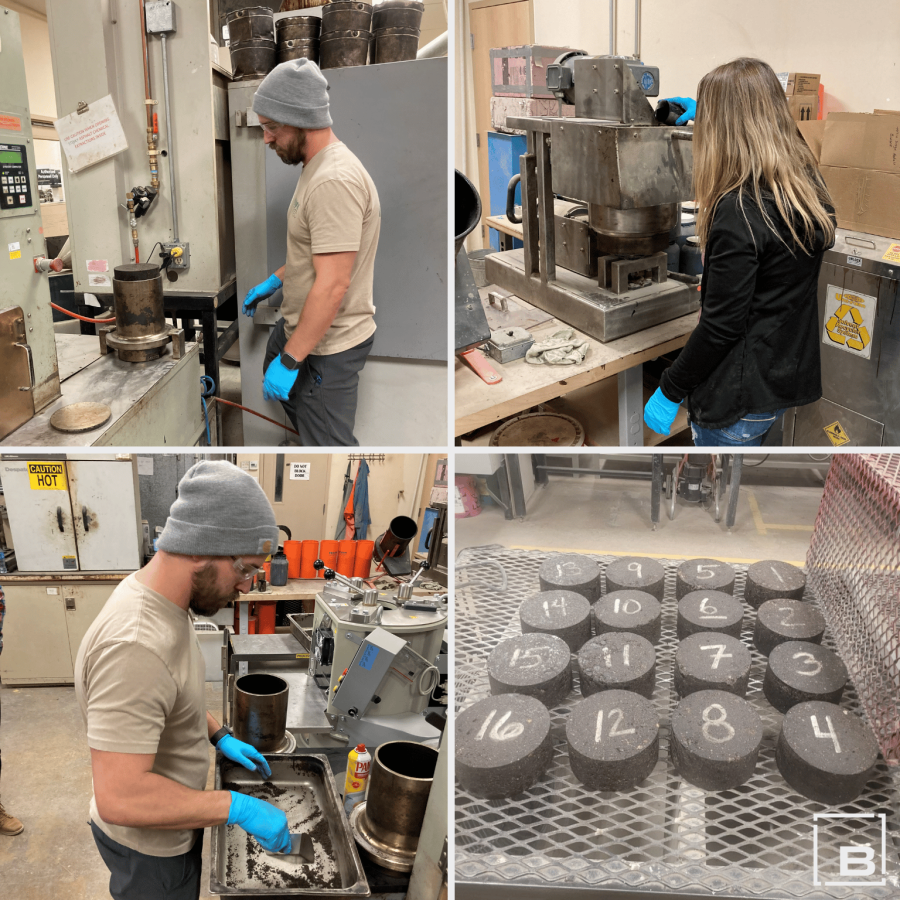
The lab mix design is where field observations become measurable performance inputs. In general, the workflow looks like this:
- Trim the asphalt cores to the proposed pre mill depth so the lab material matches what will be encountered in the field.
- Crush and blend the trimmed cores with aggregate base from the actual roadway
- Build gradations that reflect the target design structure for the recycled layer.
- Set water content to support consistent specimen preparation and compaction.
- Prepare test specimens at multiple emulsion contents so we can compare performance across stabilizer percentages.
- Cure and compact specimens in a consistent manner to reflect expected behavior after construction.
- Perform lab testing to evaluate strength and stability of the stabilized material.
- Evaluate results and select the most cost-effective stabilizer percentage that meets design requirements.
If you want a sense of the rigor behind that summary, here are a few representative details from the process:
- We typically need 35 cores and 400 pounds of aggregate base to complete the laboratory mix design.
- We prepare over 30 lab specimens from the materials collected from the roadway to evaluate multiple stabilizer contents.
- Our testing focuses on strength and stability to support long-term performance in the field.
How We Choose Stabilizer Content
In a mix design, more stabilizer is not automatically better. The objective is performance and reliability at the right cost point.
By preparing specimens at multiple emulsion contents, we can compare results and identify the stabilizer percentage that meets design needs without adding unnecessary cost. This approach helps owners defend design decisions with data and reduces the chance of field adjustments that impact schedule or budget.
Performance Lens: Thermal Cracking Potential
A key performance consideration in cold recycling and stabilization is how the material behaves through temperature swings. One way to evaluate this is by looking at thermal cracking potential using critical cracking temperature. In practical terms, this helps us understand how susceptible the stabilized layer may be to cracking under cold weather conditions, and it supports a more confident recommendation for long term pavement behavior.
What You Get as the Client
At the end of the mix design process, you receive clear guidance you can use for planning and construction:
- A recommendation for stabilizer content tied to test results
- Recommended field checks or adjustments based on project conditions
- Added confidence that the recommended recycling approach is built around your specific roadway, not simply a generic assumption
This is the value of bringing the lab into the decision process. The mix design makes the recommendation more defensible, more predictable, and more aligned with long term performance goals.
If you are considering CIR or SFDR for an upcoming rehabilitation project, we can help you with a mix design recommendation you can stand behind.
Start with a pavement evaluation conversation. We will review your objectives and constraints, confirm the right field inputs, and develop a lab mix design that supports confident decisions and long-term pavement performance.
What is a CIR/SFDR mix design?
A laboratory CIR/SFDR mix design evaluates stabilized reclaimed materials using lab specimens and testing, so the recommended stabilizer content supports strength, stability, and long-term performance.
Why do coring, GPR, and FWD matter before CIR or SFDR?
Cores, GPR, and FWD provide inputs on materials, thickness, and pavement response that help inform the recommended design approach before the lab mix design begins.
How do you decide how much emulsion to use?
We prepare specimens at multiple emulsion contents, test performance, and select the most cost-effective stabilizer percentage that meets design requirements.
Field data tells the story. The mix design makes it actionable.
Together, field data and laboratory mix design provide a clear, cost-effective path forward for CIR and SFDR, backed by performance data and built for long-term results.
If you are evaluating a roadway for recycling, start with the right data and a mix design that reflects your actual conditions. The decisions you make up front can directly impact performance, cost, and confidence through construction and beyond.
Services:
Markets:
Contact Us
We are committed to reliable, responsive communication with our clients and potential clients. Our employee-owners are here to help and answer any questions you may have. We look forward to hearing from you.