Testing Up Front Helps You Choose the Right Pavement Repair
Services:
Markets:
Contact Us
We are committed to reliable, responsive communication with our clients and potential clients. Our employee-owners are here to help and answer any questions you may have. We look forward to hearing from you.

Testing Up Front Helps You Choose the Right Pavement Repair
Visible pavement distress doesn’t always tell the full story. Two roads can look similar on the surface and fail for entirely different reasons below it. Without understanding what’s happening within the pavement structure, selecting the right repair becomes a guessing game.
Strategic pavement testing helps remove that uncertainty. By gathering the right data early, owners can make informed decisions that align repair strategies with actual pavement conditions often extending pavement life and reducing the risk of costly surprises during construction.
Why Pavements Fail and Why Appearances Can Be Misleading
Cracking, rutting, and surface distress may signal a problem, but they don’t explain why the problem exists. Is the issue confined to the surface? Is the structure no longer supporting current traffic loads? Were the wrong materials used during construction? Are there underlying subgrade issues?
Relying on surface observations alone can lead to under-designed repairs or over-designed solutions that exceed what the pavement needs. Testing provides clarity so rehabilitation strategies are based on evidence, not assumptions.
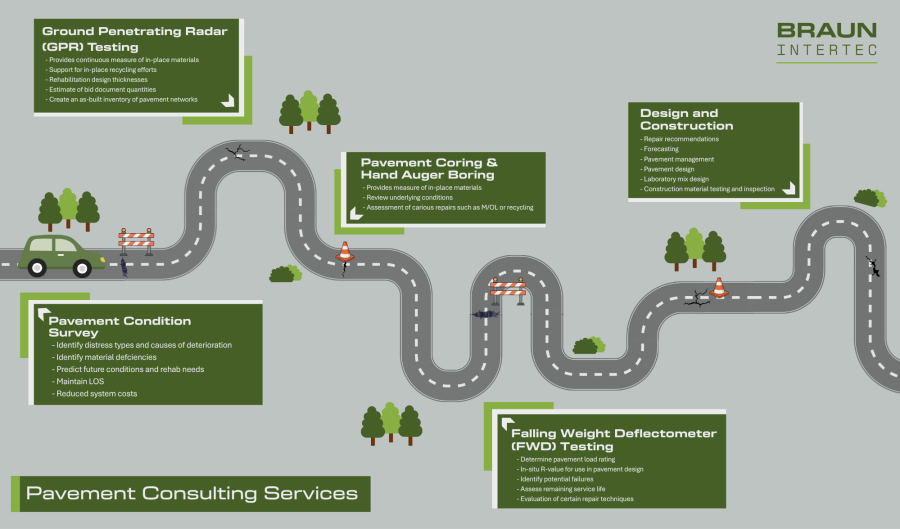
A Practical Roadmap: Each Test Answers a Specific Question
Pavement evaluation works best when testing is intentional and coordinated. Each method provides a piece of the story, and together they create a clearer picture of pavement condition and performance.
What Are My Layer Thicknesses and Where Do They Change?
Ground Penetrating Radar (GPR) provides a continuous estimate of pavement layer thicknesses across the roadway. This is especially valuable for identifying variability that may not be apparent from discrete sampling alone.
Why it matters:
Knowing layer thicknesses helps determine which rehabilitation options are viable and supports more accurate structural analysis. GPR data is also commonly used to inform and calibrate Falling Weight Deflectometer (FWD) results.
Can This Pavement Handle Current and Future Traffic Loads?
Falling Weight Deflectometer (FWD) testing evaluates how the pavement responds to a wheel-like impulse load by measuring surface deflections.
Why it matters:
FWD data helps assess load-carrying capacity and determine whether the existing structure can support anticipated traffic. This information is critical when deciding if structural improvements are needed or if a simpler rehabilitation approach is sufficient.
What Are the Underlying Materials and What Condition Are They In?
Coring and hand augers provide direct confirmation of layer thicknesses and allow engineers to evaluate the condition of in-place materials, particularly bituminous layers.
Why it matters:
These samples validate non-destructive testing results and offer detailed insight into material condition. They are especially useful when determining whether a pavement is a good candidate for mill-and-overlay or if deeper rehabilitation is warranted.
Reducing Risk Before Construction Begins
Testing doesn’t just inform design. It helps mitigate construction risk. When pavement structure and condition are well understood:
- Repair recommendations are more accurate
- Bid quantities are better defined
- Unanticipated field changes are less likely
This reduces uncertainty for owners, designers, and contractors alike.
Better Information Leads to Better Outcomes
When pavement decisions are supported by the right data, repair strategies can be matched to actual conditions, not just surface symptoms. The result is more reliable performance, better use of project funds, and pavements that meet service life expectations.
Testing up front is an investment in clarity. In many cases, it helps avoid premature failures, unnecessary scope, and costly mid-project adjustments later.
Let’s Talk About Your Pavement Objectives
Every pavement is different, and so are the constraints driving rehabilitation decisions. If you’re evaluating repair options, Braun Intertec can help you review your objectives, traffic demands, and budget considerations and identify the testing approach that supports informed, defensible decisions.
Start with a pavement evaluation conversation.
Services:
Markets:
Contact Us
We are committed to reliable, responsive communication with our clients and potential clients. Our employee-owners are here to help and answer any questions you may have. We look forward to hearing from you.