Understanding Construction Vibration: Steady State vs. Transient
Services:
Markets:
Contact Us
We are committed to reliable, responsive communication with our clients and potential clients. Our employee-owners are here to help and answer any questions you may have. We look forward to hearing from you.

Understanding Construction Vibration: Steady State vs. Transient
Key Takeaways:
- Construction vibrations fall into two categories: steady state (continuous) and transient (impact driven. Each affects structures differently.
- Steady state vibrations can create cumulative movement over time, while transient vibrations often produce higher peak intensity levels.
- Proactive vibration planning, including pre-construction condition surveys and real-time monitoring, helps reduce risk, prevent damage claims, and maintain project momentum.
- Partnering with an experienced building science team, provides data-driven decisions and confidence when working near sensitive or adjacent structures.
When should vibration monitoring be considered on a construction project?
Vibration monitoring is recommended when construction occurs near existing buildings, utilities, or sensitive equipment. It is especially valuable for projects involving vibratory compaction, pile driving, demolition, or excavation. Construction projects often generate vibrations, but not all vibrations behave the same. Understanding the difference between steady state and transient vibrations is critical when evaluating potential impacts on nearby structures. At Braun Intertec, our building science experts help clients assess, monitor, and manage vibration risks to protect adjacent buildings, infrastructure, and sensitive equipment. Knowing what type of vibration is occurring is the first step in developing the right mitigation strategy.
How do I know whether my project is producing steady state or transient vibrations?
Steady State Vibrations: The Continuous “Buzz”
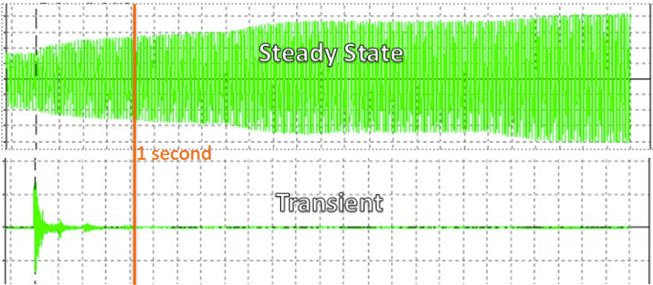
Steady state vibrations are continuous, repetitive vibrations often described as a “buzzing” sensation. These are typically generated by activities such as:
- Vibratory pile driving
- Vibratory soil compactors
- Aggregate pier installation
Because these vibrations occur in rapid succession, a structure does not fully respond to one vibration impulse before the next one occurs. This ongoing energy input can lead to cumulative movement, particularly in older or more sensitive buildings. While steady state vibrations are often lower in peak intensity than impact events, their continuous nature can still raise concerns for adjacent property owners.
Transient Vibrations: The Impact “Bang”
Transient vibrations, on the other hand, are impact-driven and occur as individual events. Common sources include:
- Hammer pile driving
- Demolition
- Excavation activities
- Dropped loads
- Blasting operations
With transient vibrations, a structure experiences a single vibration impulse and returns to its resting state before the next impulse occurs. These vibrations often produce higher peak particle velocities (PPV), generally at higher frequencies; while buildings may respond differently depending on frequency, PPV remains a key metric used in regulatory limits and structural damage criteria.
Why Distinction Matters
From a building science perspective, the type of vibration influences:
- How structures respond
- What monitoring methods are appropriate
- How risk is evaluated
- What mitigation strategies may be required
Why choose Braun Intertec?
Braun Intertec’s building science team develops vibration management plans tailored to project conditions to protect sensitive buildings and nearby infrastructure Through pre-construction condition assessments, real-time vibration monitoring, and expert interpretation of data, Braun Intertec helps project teams minimize risk and address concerns proactively. Whether your project involves vibratory compaction near existing facilities or impact-driven demolition in an urban setting, understanding vibration behavior is key to protecting surrounding structures and maintaining project momentum.
Learn how early planning and monitoring can support your project by contacting one of our experts: Contact Us!
Services:
Markets:
Contact Us
We are committed to reliable, responsive communication with our clients and potential clients. Our employee-owners are here to help and answer any questions you may have. We look forward to hearing from you.