What the ESA “Harm” Rule Change Means for Your Projects
Services:
Markets:
Contact Us
We are committed to reliable, responsive communication with our clients and potential clients. Our employee-owners are here to help and answer any questions you may have. We look forward to hearing from you.

What the ESA “Harm” Rule Change Means for Your Projects
On September 14, 2026, one of the most significant shifts in Endangered Species Act enforcement in decades takes effect, and it could change how your next project moves forward.
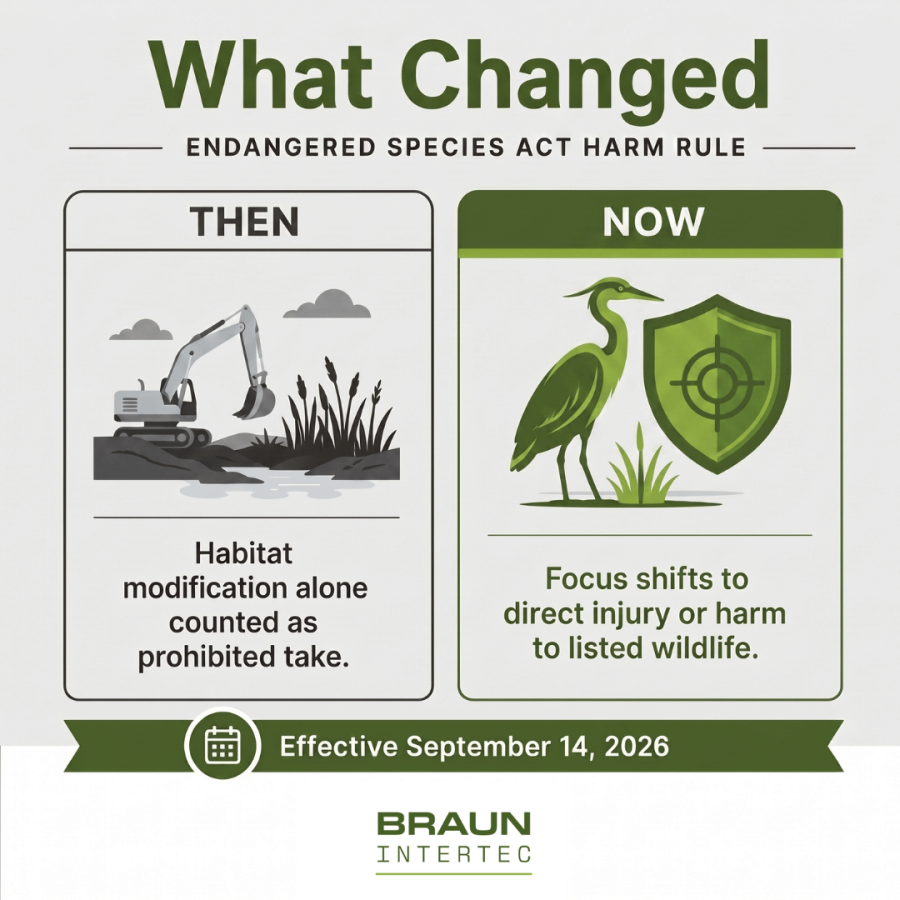
The U.S. Fish and Wildlife Service and the National Marine Fisheries Service have removed the long-standing regulatory definition of “harm” from their ESA rules. For more than 40 years, that definition treated significant habitat modification as a form of prohibited “take,” even when a project never directly touched a listed animal. That single word shaped permitting, timelines, and budgets across land development, energy, and infrastructure work.
Here is what the change gives you: a clearer line between what does and does not trigger ESA “take.” Going forward, the agencies will read “take” straight from the statute. Habitat modification on its own will no longer be treated as harm. The focus shifts toward activities that directly injure or kill listed wildlife. For you, that can mean fewer permitting hurdles when habitat is the only concern, and more predictability as you plan.
What changes, and what stays the same
The headline is easy to misread. This change is meaningful, and it is also narrower than it first appears. Knowing the difference protects your timeline.
What changes: Habitat modification, standing alone, will no longer count as prohibited “take.” If your activity affects habitat but does not directly kill, injure, or capture listed wildlife, you may no longer need incidental take authorization for that habitat effect. For many landowners and developers, that removes a step that once added months and cost.
What stays the same: This is the part that keeps projects out of trouble.
- If a federal agency authorizes, funds, or carries out your project, Section 7 consultation still applies.
- Obligations tied to jeopardy and to designated critical habitat do not go away.
- Direct effects on listed animals still require authorization.
- Existing permits and incidental take statements remain valid, since the rule applies only going forward.
- State endangered species laws are untouched.
The biggest question for your project is whether it has a lead federal agency. A project with a federal nexus follows one path. A project without one follows another. That single distinction shapes what you need, and reading it wrong in either direction creates risk.
Your next steps
A rule change is only useful if you know what to do with it. Here is a short checklist to put this update to work:
- Confirm your federal nexus. Identify whether a federal agency authorizes, funds, or carries out your project. This one answer drives most of what follows.
- Separate direct from indirect effects. Map where your activity could directly injure or kill listed wildlife versus where it only affects habitat.
- Revisit anything pending. For permits and consultations in progress, reassess your anticipated take and mitigation under the narrower interpretation before you finalize.
- Leave existing permits in place. Current permits and incidental take statements remain valid. Coordinate before requesting any changes.
- Watch the litigation. The rule has already been challenged in court, so build a little flexibility into long-range plans.
The rule takes effect September 14, 2026. Reviewing your active and upcoming projects now gives you room to adjust scope, sequencing, and documentation while you still have options, rather than reacting later.
Our environmental scientists and permitting specialists work across ESA Section 7 and Section 10, habitat assessments, and agency coordination every day. We translate a shifting regulation into a clear path for your site, so you can protect your schedule, manage cost, and stay on solid footing if the rules move again.
Let us review your project list together and flag where this change helps you and where a closer look is worth the time.
Services:
Markets:
Contact Us
We are committed to reliable, responsive communication with our clients and potential clients. Our employee-owners are here to help and answer any questions you may have. We look forward to hearing from you.